
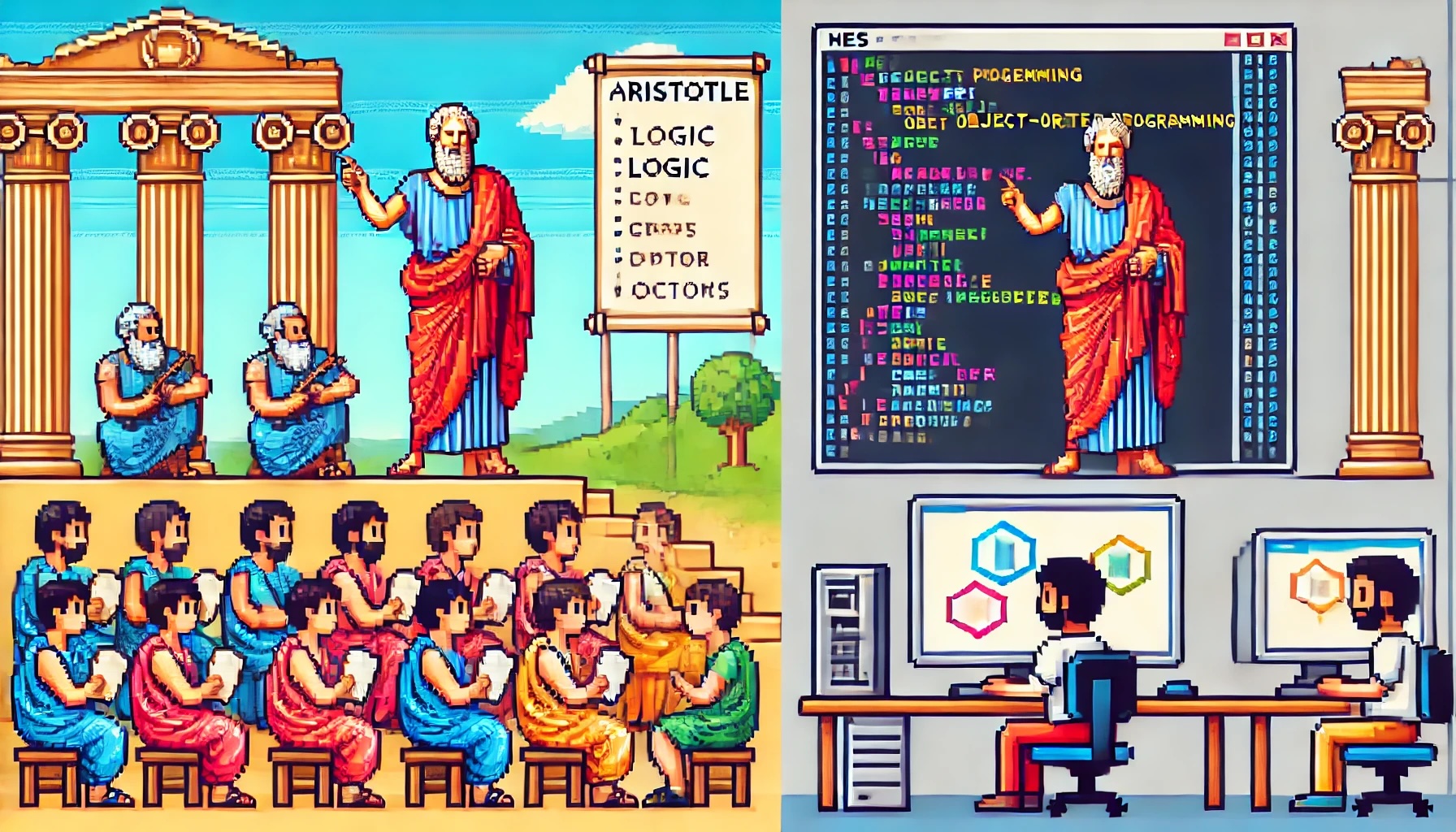
Aristotle’s “Organon” and Object-Oriented Programming
Aristotle and the “Organon”: Foundations of Logical Thought
Aristotle, one of the greatest philosophers of ancient Greece, made substantial contributions to a wide range of fields, including logic, metaphysics, ethics, politics, and natural sciences. Born in 384 BC, Aristotle was a student of Plato and later became the tutor of Alexander the Great. His works have profoundly influenced Western thought for centuries.
One of Aristotle’s most significant contributions is his collection of works on logic known as the “Organon.” This term, which means “instrument” or “tool” in Greek, reflects Aristotle’s view that logic is the tool necessary for scientific and philosophical inquiry. The “Organon” comprises six texts:
- Categories: Classification of terms and predicates.
- On Interpretation: Relationship between language and logic.
- Prior Analytics: Theory of syllogism and deductive reasoning.
- Posterior Analytics: Nature of scientific knowledge.
- Topics: Methods for constructing and deconstructing arguments.
- On Sophistical Refutations: Identification of logical fallacies.
Together, these works lay the groundwork for formal logic, providing a systematic approach to reasoning that is still relevant today.
Object-Oriented Programming (OOP): Building Modern Software
Now, let’s fast-forward to the modern world of software development. Object-Oriented Programming (OOP) is a programming paradigm that has revolutionized the way we write and organize code. At its core, OOP is about creating “objects” that combine data and behavior. Here’s a quick rundown of its fundamental concepts:
- Classes and Objects: A class is a blueprint for creating objects. An object is an instance of a class, containing data (attributes) and methods (functions that operate on the data).
- Inheritance: This allows a class to inherit properties and methods from another class, promoting code reuse.
- Encapsulation: This principle hides the internal state of objects and only exposes a controlled interface, ensuring modularity and reducing complexity.
- Polymorphism: This allows objects to be treated as instances of their parent class rather than their actual class, enabling flexible and dynamic behavior.
- Abstraction: This simplifies complex systems by modeling classes appropriate to the problem.
Bridging Ancient Logic with Modern Programming
You might be wondering, how do Aristotle’s ancient logical works relate to Object-Oriented Programming? Surprisingly, they share some fundamental principles!
- Categorization and Classes:
- Aristotle: Categorized different types of predicates and subjects to understand their nature.
- OOP: Classes categorize data and behavior, helping organize and structure code.
- Propositions and Methods:
- Aristotle: Propositions form the basis of logical arguments.
- OOP: Methods define the behaviors and actions of objects, forming the basis of interactions in software.
- Systematic Organization:
- Aristotle: His systematic approach to logic ensures consistency and coherence.
- OOP: Organizes code in a modular and systematic way, promoting maintainability and scalability.
- Error Handling:
- Aristotle: Identified and corrected logical fallacies to ensure sound reasoning.
- OOP: Debugging involves identifying and fixing errors in code, ensuring reliability.
- Modularity and Encapsulation:
- Aristotle: His logical categories and propositions encapsulate different aspects of knowledge, ensuring clarity.
- OOP: Encapsulation hides internal states and exposes a controlled interface, managing complexity.
Conclusion: Timeless Principles
Both Aristotle’s “Organon” and Object-Oriented Programming aim to create structured, logical, and efficient systems. While Aristotle’s work laid the foundation for logical reasoning, OOP has revolutionized software development with its systematic approach to code organization. By understanding the parallels between these two, we can appreciate the timeless nature of logical and structured thinking, whether applied to ancient philosophy or modern technology.
In a world where technology constantly evolves, grounding ourselves in the timeless principles of logical organization can help us navigate and create with clarity and precision. Whether you’re structuring an argument or designing a software system, these principles are your trusty tools for success.